
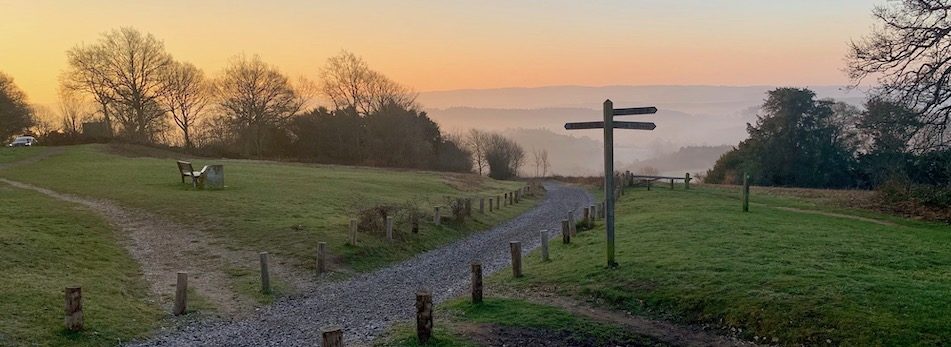
About 4 miles southeast of Guildford, the parish of Albury encompasses a rural area in the Surrey Hills, including the main village of Albury and the hamlets of Farley Green, Brook, Little London, and Newlands Corner.
Albury has Saxon origins, with settlement patterns reflecting its position in the valley between the North Downs and the Greensand Ridge. Originally located beside the Saxon church and the first manor house of 1042, Albury appears in the Domesday Book of 1086. The area was well-wooded and agricultural, with dispersed farmsteads typical of the Wealden landscape.
Author and landscape gardener John Evelyn, of nearby Wotton House, laid out the park for Henry Howard in the mid 1600s, including terraces a quarter of a mile long, a canal, a 'Roman' bath and a tunnel running north beneath Silver Wood to resemble the grotto of Sejanus at Posillipo.
In 1784, Albury Estate owner Captain Finch closed the direct road through through Albury Park to Shere. A dramatic transformation occurred from 1811 as owner Charles Wall cleared the original village in the parkland, which had been beside the Tillingbourne and west of the medieval church. After banker Henry Drummond acquired the estate in 1819 he built smart estate houses one mile along the valley at Weston, featuring distinctive and individual chimneys designed by Augustus Welby Pugin, 63 of which Pugin installed during redevelopment of the manor house itself. This 'model village' approach was typical of wealthy landowners who wished to keep development away from their parkland views while providing improved housing for workers and tenants. In 1820, Drummond also built New Road and Sherbourne, closing Dog Kennel Lane which ran past Keeper's Cottage, Albury Green , the George Inn (now Grange Cottage) and Cooke's Place, then a farmery.
The old Saxon and Norman St Peter and St Paul's Church fell into disrepair after the village clearance. In the 1840s, Drummond commissioned William McIntosh Brookes to build a new parish church in Rudge's Field, above the relocated village centre and based on Thaon church in Normandy. The old church survives under the Churches Conservation Trust with notable features, including a Saxon doorway, a wall painting of St. Christopher and the ornate Drummond mortuary chapel, designed by Pugin. Drummond also constructed the Catholic Apostolic Church (1840) following the 'Albury Conferences' held in the 1820s which had founded the movement. The building closed after the deaths of its founders to await the Second Coming.
Albury passed into the hands of the Northumberland family after Louisa, Drummond's daughter, married Lord Lovaine who became the 6th Duke of Northumberland. The estate continues to manage much in Albury though the mansion was sold in 1969 and has been private apartments since then.
Farley Green developed around Farley Heath, site of a Roman temple first excavated in the 19th century by the poet, author and Albury resident Martin Farquhar Tupper. In 1930, Clara Courtney-Wells gave her 19th century barn as a memorial to her husband: the Barn Church, St. Michael's.
Brook is a small hamlet that grew along the Lawbrook stream, where there was a mill. Further downstream, before the tributary joins the Tillingbourne at Waterloo Pond, Ford Farm had watercress beds.
Little London is a scattered hamlet on higher ground, typical of Surrey's assart settlements, clearings made in medieval woodland.
Newlands Corner, now known as a viewpoint on the A25, gained notoriety in 1926 when Agatha Christie's car was found abandoned there during her mysterious disappearance.
with many thanks to Trevor Brook/The Albury History Society (alburyhistory.org.uk) - lots of stories and hundreds of photographs!